Tax Legislation Update: 2010-2011 Expiring Federal Tax Provisions
By Nancy Faussett, CPA
Publication Date: 02/18/2011
Introduction
While the Tax Relief, Unemployment Insurance Reauthorization, and Job Creation Act of 2010 (a.k.a., the 2010 Tax Relief Act) extended a large number of expiring (and expired) tax benefits, it did not extend all of them. There are still many federal tax provisions that expired at the end of 2010 and even more that, unless extended by new legislation, will expire at the end of 2011. This article will give you a brief description of the major tax provisions that are expiring.
Download a PDF version of this article »
2010 Expired Tax Provisions
Unless otherwise noted, the following tax provisions expired on December 31, 2010.
Fixed Assets
The following provisions affect fixed assets:
Alternative Motor Vehicle credit for vehicles that are lean-burn technology vehicles, qualified hybrid motor vehicles, or qualified alternative fuel vehicles (Sec. 30B(k))
The Energy Tax Incentives Act of 2005 created the Alternative Motor Vehicle credit for vehicles using alternative fuels.
Alternative fuel vehicle refueling property - increase in credit rate and credit cap (non-hydrogen) (Sec. 30C(e)(6))
For qualifying property placed in service in 2009 and 2010, the credit rate is increased to 50% of the cost of any qualified alternative fuel vehicle (non-hydrogen) refueling property. Also, for qualifying property placed in service in 2009 and 2010, the credit limit is increased to $50,000 for commercial clean-fuel property and $2,000 for residential clean-fuel property.
5-year amortization of music and music copyrights (Sec. 167(g)(8))
Expenses relating to creating or acquiring any qualifying musical composition (or related copyright) can be amortized over a five-year period.
15-year recovery period for natural gas distribution lines (Sec. 168(e)(3)(E))
Increase in amount allowed as a deduction for start-up expenditures (Sec. 195(b)(3))
The amount allowed as a deduction for startup expenses in 2010 is temporarily increased from $5,000 to $10,000.
Special rule for long-term contract accounting − allocation of bonus depreciation (Sec. 460(c)(6))
The Small Business Jobs Act of 2010 allows bonus depreciation that is claimed on assets with a recovery period of seven years or less to be disregarded when computing the percentage-of-completion for long-term contracts. This applies to such property placed in service after 2009 and before 2011 (before 2012 for longer production period property).
Businesses
The following provisions are business-related:
Work Opportunity Tax Credit for certain specified target groups (Sec. 51(d)(14))
The Work Opportunity Credit is available to employers hiring unemployed veterans and “disconnected youth” hired in 2009 or 2010.
General business credits of eligible small businesses not subject to the Alternative Minimum Tax (AMT) (Sec. 38(c)(5))
For taxable years beginning in 2010, the tentative minimum tax is treated as zero for purposes of determining the tax liability limitation for the general business credit of eligible small businesses. Therefore, an eligible small business credit can offset both regular tax and AMT liability. “Eligible small business credits” are the sum of the general business credits determined for a taxable year for an eligible small business.
General business credits of eligible small businesses carried back five years (Sec.39(a)(4))
For the taxpayer’s first tax year beginning in 2010, an eligible small business can carry back its general business credit five years (instead of only to the preceding year) and forward 20.
Payroll tax forgiveness for hiring unemployed workers (Sec. 3111(d))
There is a temporary payroll tax holiday that exempts “qualified employers” from paying the 6.2% OASDI portion of FICA taxes for wages paid between March 19, 2010, and December 31, 2010, for new employees if certain conditions are met.
Business credit for retention of certain newly hired individuals in 2010
There is a provision that does two things to encourage businesses to hire workers who have been unemployed for at least 60 days (or have worked fewer than 40 hours during those 60 days):
- There is a tax credit of up to $1,000* for each employee hired and retained for 52 weeks, under the Section 38 General Business Credit, and
- Employers will be exempt from Social Security payroll taxes (i.e., the 6.2% Social Security tax on wages) for every employee hired after February 3, 2010, and before January 1, 2011.
*The amount of the credit is the lesser of $1,000 or the 6.2% of wages and, due to the retention requirement, will first be available on the employer’s 2011 tax return.
Qualifying therapeutic discovery project credit (Sec. 48D)
Taxpayers that make a qualified investment in a qualifying therapeutic discovery project are allowed a 50% tax credit for qualifying expenditures.
Qualified school construction bonds – allocation of bond authority (Sec. 54F(c)(3))
There is a national limitation on qualified school construction bonds of $11 billion for calendar years 2009 and 2010.
Authority to issue Build America Bonds
Build America Bonds are taxable governmental bonds with federal subsidies for a portion of their borrowing costs. They are used by state and local governments to reduce the costs of financing for infrastructure projects.
Modification of AMT limitations on tax-exempt bonds (Secs. 57(a)(5)(C)(vi) and 56(g)(4)(B)(iv))
The interest on private activity bonds issued in 2009 or 2010 is not treated as a tax preference item.
Deferral and ratable inclusion of income from business debt discharged by reacquisition (Sec. 108(i))
There is allowed a deferral and ratable inclusion of income arising from business indebtedness discharged by the reacquisition of a debt instrument if done before 2011.
Individuals
The following provisions affect individual taxpayers:
First-time homebuyer credit (Sec. 36)
This is a credit for taxpayers buying their first home. The credit is the lesser of 10% of the home’s purchase price or $8,000. The Worker, Homeownership, and Business Assistance Act of 2009 extended (and expanded) the credit through April 30, 2010. However, if someone entered into a binding contract before May 1, 2010, to close on the purchase of the residence before July 1, 2010, they can still claim the credit as long as the purchase is completed before October 1, 2010.
Making Work Pay Credit (Sec. 36A)
Subject to certain income limitations, working taxpayers receive the lesser of:
- 6.2% of the taxpayer’s earned income, or
- $400 ($800 if a joint return).
Income exclusion for benefits given to volunteer firefighters and emergency medical responders (Sec. 139B)
There is an exclusion from gross income for individuals on account of services performed as a member of a qualified volunteer emergency response organization.
Allowing computer technology and equipment as qualified Section 529 account expense (Sec.529(e)(3)(A)(iii))
Expenses paid or incurred for purchasing computer equipment or Internet access are considered to be qualified higher education expenses for a Section 529 account (i.e., a qualified tuition program). “Qualified tuition programs” generally allow taxpayers to prepay and guarantee college education costs.
Estate and gift taxes:
- Election for executors of estates of decedents dying during 2010 to apply the 2010 EGTRRA estate tax and modified carryover basis rules
- Zero rate for generation skipping transfer tax
- $1 million gift tax exemption (Sec. 2505)
Acceleration of income tax benefits for charitable cash contributions for relief of victims of earthquake in Haiti
This provision expired on February 28, 2010.
Treatment of residences located in the Gulf Opportunity Zone, the Rita GO Zone, or the Wilma GO Zone as targeted area residences for purposes of mortgage revenue bond rules (Sec. 1400T)
Tax relief for areas damaged by 2008 Midwestern severe storms, tornados, and flooding
In 2008, Congress extended much of the tax relief provided to the GO Zone and the Kansas disaster area to the Midwestern disaster area, including the following provisions expiring at the end of 2010:
- Low-income housing tax credit relief - Expensing for demolition and clean-up costs
- Extension of expensing for environmental remediation costs
- Special rules for mortgage revenue bonds
- Treatment of net operating losses attributable to disaster losses
Low-income housing tax relief for areas damaged by Hurricane Ike in 2008
In 2008, Congress authorized the issuance of qualified private activity bonds to finance the construction and rehabilitation of residential and nonresidential property located in the Hurricane Ike disaster area.
Sixty-five percent subsidy for payment of COBRA health care coverage continuation premiums
There was a temporary 65% subsidy of COBRA premiums available for individuals whose employment was involuntarily terminated between September 1, 2008, and May 31, 2010.
Qualified mortgage bonds for refinancing of subprime loans (Sec. 143(k)(12))
The proceeds of a qualified mortgage issue before January 1, 2011 can be used to refinance a mortgage on a residence that was originally financed through a qualified subprime loan.
Bonds guaranteed by Federal Home Loan banks eligible for treatment as tax-exempt bonds (Sec. 149(b)(3)(A)(iv)
Deduction for health insurance costs in computing selfemployment taxes (Sec.162(l)(4))
Self-employed individual taxpayers can generally deduct the amount paid during the tax year for health insurance. This deduction is not taken into account in computing the taxpayer’s net earnings from self-employment for purposes of the tax on self-employment income in 2010.
2011 Expiring Tax Provisions
empUnless otherwise noted (and, unless extended by new legislation), the following tax provisions will expire on December 31, 2011.
Fixed Assets
The following provisions affect fixed assets (in addition, see below for the provisions affecting empowerment zones and disaster areas):
Additional first-year depreciation for 100 percent of basis of qualified property (Sec.168(k)(5))
The bonus depreciation deduction for qualifying property placed in service after September 8, 2010, and through 2011 (through 2012 for certain aircraft and long-production-period property) was increased to 100%. Note that the 50% bonus depreciation deduction will be available after December 31, 2011.
Increase in expensing to $500,000/$2,000,000 and expansion of definition of Section 179 property (Secs. 179(b)(1) and (2) and 179(f))
There is a temporary increase in the maximum dollar limit and the investment threshold phaseout amounts under Section 179. (The expensing limits of $125,000/$500,000 effective after December 31, 2011, expire December 31, 2012.) There is also a temporary inclusion of certain leasehold improvement property, restaurant property, and retail improvement property in the definition of Section 179 qualifying property with the ability to claim $250,000 of Section 179 expense on it.
15-year straight-line cost recovery for qualified leasehold improvements, qualified restaurant buildings and improvements, and qualified retail improvements (Secs. 168(e)(3)(E))
Seven-year recovery period for motorsports entertainment complexes (Sec. 168(i)(15))
Accelerated depreciation for business property on an Indian reservation (Sec.168(j)(8))
There are shorter recovery periods, resulting in accelerated depreciation deductions, for qualifying business property on Indian reservations.
Credit for electric drive motorcycles, three-wheeled vehicles, and low-speed vehicles (Sec. 30(f))
The Section 30 credit applies to qualified plug-in electric vehicles, with a gross vehicle weight of less than 14,000 pounds, which are any two- or three-wheeled motor vehicle or any “low-speed” vehicle. The credit amount is 10% of the cost of the vehicle and cannot exceed $2,500 per vehicle.
Conversion credit for plug-in electric vehicles (Sec. 30B(i)(4))
To qualify for the plug-in conversion credit, the motor vehicle must be converted to a qualified plug-in electric drive motor vehicle. The credit amount is 10% of the cost of converting the vehicle not to exceed $40,000 (i.e., the maximum credit is $4,000).
Alternative fuel vehicle refueling property (non-hydrogen refueling property) (Sec. 30C(g)(2))
For qualifying property placed in service in 2011, there is a credit for 30% of the cost of any qualified alternative fuel vehicle refueling property that does not relate to hydrogen. The credit is limited to $30,000 per location for commercial clean-fuel property, and $1,000 per location for residential clean-fuel property. This qualifying property has the same definition as refueling property under Section 179A(d) but the fuel must either:
- Consist of at least 85% of one or more of the following: ethanol, natural gas, compressed natural gas, liquefied natural gas, liquefied petroleum gas, or hydrogen; or
- Be a mixture of diesel fuel and at least 20% biodiesel.
(The credit for such property that relates to hydrogen expires December 31, 2014.)
Election to expense advanced mine safety equipment (Sec. 179E)
A taxpayer can make an election to treat 50% of the cost of any qualified advanced mine safety equipment as a deduction in the current year, reducing the basis of the property.
Special expensing rules for certain film and television productions (Sec. 181(f))
Section 181 allows a deduction for qualified film or television production costs, rather than capitalizing and amortizing the costs under the income forecast method.
Expensing of “brownfields” environmental remediation costs (Sec. 198(h))
A taxpayer can elect to expense rather than capitalize qualified environmental remediation (QER) expenditures. A
qualified contaminated site is known as a “brownfield.”
Businesses
The following provisions are business-related:
Tax credit for research and experimentation expenses (Sec. 41)
The Section 41 credit allows a credit for a portion of the taxpayer’s qualified research expenditures.
Work opportunity tax credit (Sec. 51(c)(4))
Employers are allowed a credit for a portion of wages paid to certain new employees who qualify as members of certain disadvantaged groups.
Credit for construction of new energy-efficient homes (Sec. 45L(g))
Contractors are allowed a credit for the construction of qualified new energy-efficient homes that achieve a specific energy savings.
Credit for energy-efficient appliances (Sec. 45M(b))
Producers are allowed a credit for the manufacture of energy-efficient appliances.
Employer wage credit for activated military reservists (Sec. 45P)
An eligible small business employer can claim a credit equal to the 20% of the sum of the eligible differential wage payments, for each qualified employee. The maximum credit per employee in any tax year is $4,000.
Indian employment tax credit (Sec. 45A(f))
Employers are allowed to claim a credit for the employment of certain Native Americans. The credit amount is 20% of the net incremental Indian employment wages.
New markets tax credit (Sec. 45D(f)(1))
The new markets credit is available to taxpayers who hold a qualified equity investment in a qualified community development entity.
Mine rescue team training credit (Sec. 45N)
An employer can claim the credit for each qualified mine rescue team employee. The credit is the lesser of: (1) 20% of the amount paid or incurred by the taxpayer during the taxable year with respect to the training program costs of such qualified mine rescue team employee (including wages of the employee while attending the program), or (2) $10,000.
Grants for specified energy property in lieu of tax credits (Sec. 48(d)
Taxpayers that place in service qualifying energy property can receive a grant from the Treasury Department in lieu of the energy credit.
Special rules for contributions of capital gain real property made for conservation purposes (Sec. 170(b)(2)(B))
There are incentives for conservation contributions by certain corporate farmers and ranchers. If a contribution qualifies, the corporation’s deduction will not be subject to the general 10% limit but, instead, will be allowed to the extent the aggregate of such contributions does not exceed the corporation’s taxable income over the charitable contributions allowed.
Certain enhanced charitable deductions (Sec. 170(e))
There are enhanced charitable deductions allowed for qualified computer contributions and book inventories to schools, as well as the enhanced charitable deduction for food inventories.
Qualified zone academy bonds – allocation of bond limitation (Sec. 54E(c)(1))
Credit for certain expenditures for maintaining railroad tracks (Sec. 45G(f))
There is a 50% credit allowed for qualified railroad track maintenance expenditures.
Modification of tax treatment of certain payments to controlling exempt organizations (Sec. 512(b)(13)(E)(iv))
Section 512(b)(13) treats as unrelated business income certain payments derived by an exempt “controlling organization” from a taxable “controlled entity” under certain circumstances, including interest, annuities, royalties, and rents.
Deduction allowable with respect to income attributable to domestic production activities in Puerto Rico (Sec. 199(d)(8))
U.S. businesses with branches in Puerto Rico can claim the deduction under Section 199 for production activities performed in Puerto Rico.
Suspension of 100 percent-of-net-income limitation on percentage depletion for oil and gas from marginal wells (Sec. 613A(c)(6)(H)(ii))
Airport and Airway Trust Fund excise taxes
The following three taxes expire on March 31, 2011:
- All but 4.3 cents-per-gallon of taxes on noncommercial aviation kerosene and noncommercial aviation gasoline
(The 4.3-cents-per-gallon rate is permanent.) (Sec. 4081(d)(2)(B)) - Domestic and international air passenger ticket taxes (Sec. 4261(j)(1)(A)(ii))
- Air cargo tax (Sec. 4271(d)(1)(A)(ii))
Highway Trust Fund excise tax rates
The following provisions expire on September 30, 2011:
- All but 4.3 cents-per-gallon of the taxes on highway gasoline, diesel fuel, kerosene, and alternative fuels (Secs. 4041(a) and 4081(d)(1))
- Reduced rate of tax on partially exempt methanol or ethanol fuel (Sec. 4041(m))
- Tax on retail sale of heavy highway vehicles (Sec. 4051(c))
- Tax on heavy truck tires (Sec. 4071(d))
- Annual use tax on heavy highway vehicles (Sec. 4481(f))
Leaking Underground Storage Tank Trust Fund financing rate (Secs. 4041(d)(4) and 4081(d)(3))
This provision expires on September 30, 2011.
Incentives for alcohol fuels:
- Alcohol fuels income tax credit (alcohol fuel, alcohol used to produce a qualified mixture, and small ethanol producers) (Secs. 40(e)(1)(A), (h)(1), and (h)(2))
- Alcohol fuel mixture excise tax credit and outlay payments (Secs. 6426(b)(6) and 6427(e)(6)(A))
Incentives for biodiesel and renewable diesel:
- Income tax credits for biodiesel fuel, biodiesel used to produce a qualified mixture, and small agri-biodiesel producers (Sec. 40A)
- Income tax credits for renewable diesel fuel and renewable diesel used to produce a qualified mixture (Sec. 40A)
- Excise tax credits and outlay payments for biodiesel fuel mixtures (Secs. 6426(c)(6) and 6427(e)(6)(B))
- Excise tax credits and outlay payments for renewable diesel fuel mixtures (Secs. 6426(c)(6) and 6427(e)(6)(B))
Placed-in-service date for facilities eligible to claim the refined coal production credit (other than refined coal facilities that produce steel industry fuel) (Sec. 45(d)(8))
Exceptions under subpart F for active financing income (Secs. 953(e)(10) and 954(h)(9))
Look-through treatment of payments between related controlled foreign corporations under the foreign personal holding company rules (Sec. 954(c)(6))
Individuals
The following provisions affect individual taxpayers:
Increased AMT exemption amount (Sec. 55(d)(1))
The AMT exemption amount has been increased on a temporary basis since 2001.
Enhanced credit for health insurance costs (Sec. 35(a))
The Health Coverage Tax Credit is a federal income tax credit available to an eligible individual that covers 65% of the costs of premiums incurred (80% for eligible coverage months beginning before January 1, 2011) to provide qualified health insurance coverage, including COBRA coverage, for the eligible individual and qualifying family members.
First-time homebuyer credit for individuals on qualified official extended duty outside the United States (Sec. 36(h)(3))
This provision expires on May 1, 2011. However, in the case of a written binding contract entered into before May 1, 2011 for the purchase of a primary residence, the purchase must close before July 1, 2011.
FUTA surtax of 0.2 percent (Sec. 3301(1))
When the Worker, Homeownership, and Business Assistance Act of 2009 extended unemployment insurance benefits, it also extended the 0.2 percent Federal Unemployment Tax Act (FUTA) surtax through June 30, 2011.
Credit for certain nonbusiness energy property (Sec. 25C(g))
Under Section 25C, individual taxpayers can claim a nonrefundable credit for a portion of the expenditures that improve the energy efficiency of homes.
Expansion of adoption credit and adoption assistance programs (Secs. 36C and 137)
Above-the-line deduction for qualified tuition and related expenses (Sec. 222(e))
There is an above-the-line deduction allowed for qualified tuition and related expenses for higher education purposes.
Deduction for certain expenses of elementary and secondary school teachers (Sec. 62(a)(2)(D))
There is a $250 above-the-line deduction for professional expenses incurred by elementary and secondary schoolteachers.
Parity for exclusion from income for employer-provided mass transit and parking benefits (Sec. 132(f))
An employee can exclude a limited amount of qualified employer-provided transportation fringe benefits from income. The transportation fringe benefits are:
(1) transportation in a commuter highway vehicle between the employee’s residence and place of employment; (2) transit passes; (3) qualified parking; and (4) a qualified bicycle commuting reimbursement.
Treatment of military basic housing allowances under low-income housing credit (Sec. 142(d))
The basic housing allowance is not included in income for the low-income credit income eligibility rule.
Premiums for mortgage insurance deductible as interest that is qualified residence interest (Sec. 163(h)(3)(E))
Deduction for state and local general sales taxes (Sec. 164(b)(5))
The deduction is only allowed if the taxpayer forgoes their deduction for state and local income taxes.
Special rules for contributions of capital gain real property made for conservation purposes (Sec. 170(b)(1)(E))
The 30% contribution base limitation on contributions of capital gain property by individuals does not apply to qualified conservation contributions. Taxpayers can deduct the fair market value of any qualified conservation contribution to a qualifying organization to the extent of the excess of 50% of the contribution base over the amount of all other allowable charitable contributions.
Tax-free distributions from individual retirement plans for charitable purposes (Sec. 408(d)(8))
There is an exclusion from gross income for otherwise taxable IRA distributions from a traditional or Roth IRA for qualified charitable distributions.
Special rules for qualified small business stock (Sec. 1202(a)(4))
Empowerment Zones
The following provisions affect the empowerment zones:
Note that the empowerment zone tax incentives may expire earlier than December 31, 2011, with respect to an empowerment zone if a State or local government provided for an expiration date in the nomination of an empowerment zone or the appropriate Secretary revokes an empowerment zone’s designation.
Designation of an empowerment zone and of additional empowerment zones (Secs. 1391(d)(1)(A)(i) and (h)(2))
Increased exclusion of gain (attributable to periods through 12/31/16) on the sale of qualified business stock of an empowerment zone business (Secs. 1202(a)(2) and 1391(d)(1)(A)(i))
Empowerment zone tax-exempt bonds (Secs. 1394 and 1391(d)(1)(A)(i))
Empowerment zone employment credit (Secs. 1396 and 1391(d)(1)(A)(i))
There is a 20% credit on the first $15,000 of qualified zone wages.
Increased expensing under Section 179 (Secs. 1397A and 1391(d)(1)(A)(i))
Qualifying Enterprise Zone property is allowed an additional $35,000 (or the cost of the qualifying property, if less) of Section 179 expense. (Note that when computing the reduction of the property’s cost limitation on account of excess Section 179 property, only half of the cost of the qualified zone property is taken into account.)
Nonrecognition of gain on rollover of empowerment zone investments (Secs. 1397B and 1391(d)(1)(A)(i))
There is a limited nonrecognition of gain from the sale of a qualified empowerment zone asset through 2011.
Disaster Areas
The following provisions provide temporary disaster relief:
New York Liberty Zone: tax-exempt bond financing (Sec. 1400L(d)(2)(D))
Tax-exempt bond financing for the Gulf Opportunity Zone (GO Zone) (Sec. 1400N(a))
Low-income housing credit - additional housing credit dollar amount for the Gulf Opportunity Zone and certain program expansions for the Gulf Opportunity Zone, the Rita GO Zone, and the Wilma GO Zone (Sec. 1400N(c))
Placed-in-service date for additional depreciation for specified Gulf Opportunity Zone extension property (Sec. 1400N(d)(6))
Specified Go Zone extension property (which includes nonresidential real property and residential rental property) qualifies for bonus deprecation through 2011. (However, certain personal property may qualify if placed in service within 90 days following December 31, 2011.)
Increase in rehabilitation credit for structures located in the Gulf Opportunity Zone and in areas damaged by 2008 Midwestern severe storms, tornados, and flooding (Sec. 1400N(h))
Section 1400N(h) increases from 20 to 26%, and from 10 to 13%, respectively, the credit under Section 47 for any certified historic structure or qualified rehabilitated building located in the Go Zone and the Midwestern disaster area.
How BNA Software Can Help
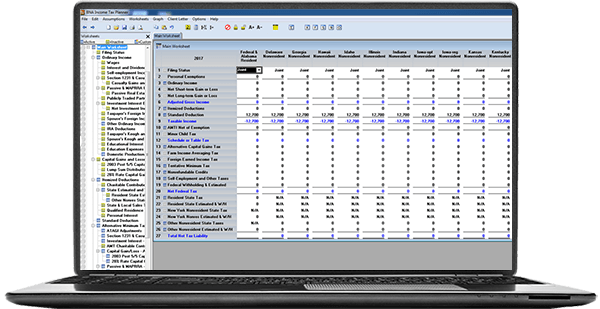
Offering the most comprehensive planning features available, BNA Income Tax™ Planner helps you efficiently model complex tax scenarios, eliminate surprises, and offer planning and projections that help clients manage and reduce their federal and state individual income tax liability. BNA Income Tax Planner allows you to quickly calculate federal income taxes including alternative minimum tax, capital gains, estimated tax payments, stock options, and more with the most accurate tax calculations available.
Top corporations such as Alcatel-Lucent, Honeywell, Northrop Grumman, Sun Microsystems, and Western Refining, as well as the IRS, trust BNA Corporate Tax™ Analyzer. It’s the only product that automates the calculation and tracking of carryforwards and carrybacks of NOLs, FTCs, AMT, GBCs, charitable contributions, and more over multiple years. With its comprehensive set of calculations, compliance, reporting and analysis, planning, and audit capabilities, BNA can enhance or replace risky, time-consuming spreadsheets, saving tax departments hundreds of hours of time and effort every year.
BNA Fixed Assets™ provides you with the ability to document your depreciation and amortization policies through Asset Type templates and allows you to automate the enforcement and implementation of these policies when performing data entry for fixed assets. This eliminates potential errors from misclassifying assets, automates the process of entering assets, enforces the use of a company’s depreciation and amortization policies, greatly reduces the volume of data required to enter each asset in the system, and, above all, guarantees compliance with GAAP rules and IRS regulations.
About BNA Software
Founded in 1983, BNA Software develops professional software solutions for tax, accounting, and financial planning professionals. With category-standard software including BNA Corporate Tax™ Analyzer, BNA Income Tax™ Planner and BNA Fixed Assets, BNA Software is the solution of choice for accounting, law, and financial planning firms, as well as corporations of every size. More than 60,000 customers including the IRS, depend upon BNA Software for the highest degree of tax, regulatory, and compliance expertise available in the market.